
Cracked teeth demonstrate many types of symptoms, including pain when chewing, temperature sensitivities, or even the release of biting pressure. It is also common for pain to come and go, making it difficult to diagnose the cause of discomfort.
Chewing can cause movement of the cracked pieces of your tooth, and the pulp within the tooth becomes irritated. At the same time, when biting pressure is released, the crack can close quickly, resulting in sharp pain. Eventually, the pulp will become damaged and tooth will consistently hurt, even when you are not chewing. It is possible that cracks can lead to infection of the pulp tissue, which can spread to the bone and gum surrounding the problematic tooth.
Examples of Cracked Teeth
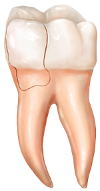
Fractured Cusp
When a cusp (the pointed part of the chewing surface) becomes weakened, a fracture sometimes results. The weakened cusp may break off by itself or may have to be removed by the dentist. When this happens, the pain is usually relieved. A fractured cusp rarely damages the pulp (nerve tissues), so root canal treatment is seldom needed. The tooth is usually restored by your family dentist with a full crown.

Split Tooth
A split tooth is often the result of the long-term progression of a cracked tooth. The split tooth is identified by a crack with distinct segments that can be separated. A split tooth can never be saved intact. The position and extent of the crack, however, will determine whether any portion of the tooth can be saved. In rare instances, endodontic treatment and a crown or other restoration by your dentist may be used to save a portion of the tooth.

Vertical root fracture
Vertical root fractures are cracks that begin in the root of the tooth and extend toward the chewing surface. They often show minimal signs and symptoms and may go unnoticed for some time. Vertical root fractures are often discovered when the surrounding bone and gum become infected. Treatment usually involves extraction of the tooth. However, endodontic surgery is sometimes appropriate if a portion of the tooth can be saved by removal of the fractured root.
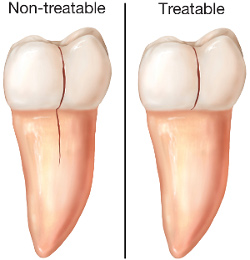
Cracked Tooth
A cracked tooth means a crack extends from the chewing surface of your tooth vertically toward the root. The tooth is not yet separated into pieces, though the crack may gradually spread. Early diagnosis is important in order to save the tooth. If the crack has extended into the pulp, the tooth can be treated with a root canal procedure and a crown to protect the crack from spreading.
However, if the crack extends below the gum line, it is no longer treatable, and the tooth cannot be saved and will need to be extracted. That’s why early treatment is so important. A cracked tooth that is not treated will progressively worsen, eventually resulting in the loss of the tooth. Early diagnosis and treatment are essential in saving these teeth.

Craze Lines
Craze lines are tiny cracks that affect only the outer enamel. These cracks are extremely common in adult teeth. Craze lines are very shallow, cause no pain, and are of no concern beyond appearances.